Our history
The Origins of Robotics at Oxford
Although the ORI was formed in 2016, robotics research at the University of Oxford goes back much further. Prof. Sir Michael Brady FRS formed the original Robotics Research Group (RRG) in 1985, which carried out influential early research in mobile robotics. The RRG developed into what is now the Information Engineering Panel, which also conducts research in computer vision and machine learning and spans different groups and institutes within the Department of Engineering Science.
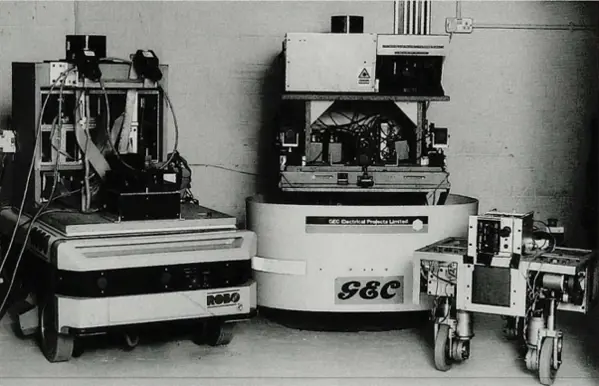
In 1988, the RRG team, led by Prof. Sir Brady, developed a real-time autonomous mobile robot which carried out sensor fusion from vision and sonar sensors. The robot could navigate a slalom course of obstacles using real-time perception.
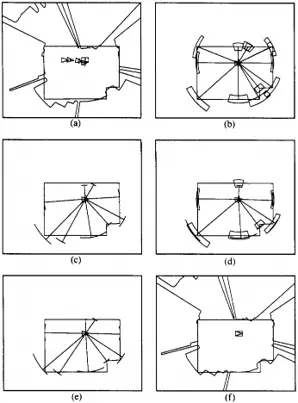
Subsequent research in the field of robotic mapping was led by Prof. Hugh Durrant-Whyte FRS. Prof. Durrant-Whyte is credited with the invention of the phrase SLAM (Simultaneous Localisation and Mapping), which formally defined the problem of combining sensor information of a moving robot into a consistent map while in motion using only the robot’s onboard processing power.
Durrant-Whyte left Oxford to form the Australian Centre for Field Robotics (ACFR) in Sydney. However, Prof. Paul Newman, who completed a PhD student under supervision of Prof. Durrant-Whyte at ACFR in the late 1990s, went on to re-establish mobile robotics research at Oxford.
The Early Days
In 2003, Prof. Newman founded the Mobile Robotics Group (MRG) to research robot navigation in real-world conditions and at scale. In 2005, Ingmar Posner joined the MRG as a postdoctoral researcher focusing on machine learning in robotics for perception, planning and decision-making. The MRG developed world-leading methods for visual localisation and navigation, such as FABMAP, and produced influential demonstrations.
By 2011, a new research group, the Applied Artificial Intelligence Lab (A2I), led by Prof. Ingmar Posner, emerged from the MRG. The group focuses on the core challenges in AI and machine learning and explores ways for robots to effectively operate in complex, real-world environments.
Major projects included the WildCat project, which was a five-year collaboration with BAE Systems, Nissan and EPSRC to build a fully autonomous vehicle that fed directly into ORI's driverless car research.

Nissan Leaf that was adapted into the RobotCar in 2012 by MRG

The modified Bowler WildCat

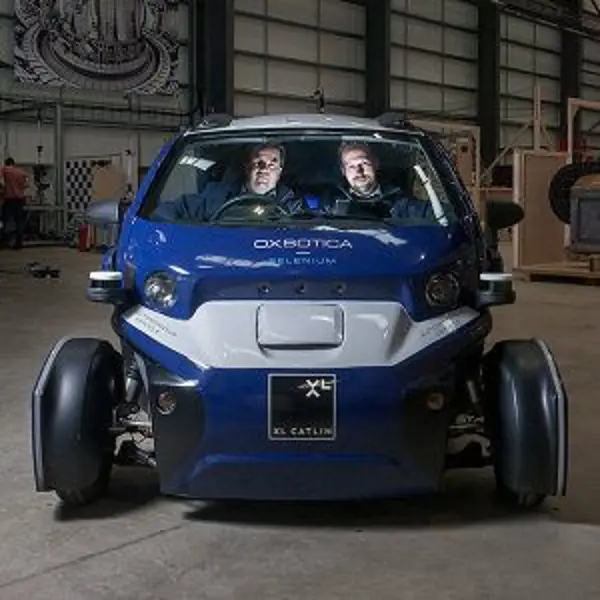
One of the pods from the LUTZ Pathfinder project in Milton Keynes
In 2012, MRG and A2I adapted a Nissan Leaf into a RobotCar. In 2014, it became the first car to drive autonomously on UK public roads. It is now on display at the Science Museum, and the research formed the basis for the Oxford RobotCar dataset.
In 2015, in collaboration with Milton Keynes Council, Prof. Posner led a team on the LUTZ Pathfinder project. The project applied the autonomous control systems developed by MRG and A2I to three prototype microcars (informally known as pods). The team demonstrated the UK’s first trials of fully autonomous vehicles in pedestrianised zones around Milton Keynes train station and shopping centre. The project won the prestigious Society of Motor Manufacturers and Traders Award for Automotive Innovation.
Findings from the three LUTZ pods also fed into the larger-scale UK Autodrive project, which aimed to establish the UK as a global hub for autonomous vehicle development and to integrate self-driving vehicles into existing urban environments.
During this time, Oxbotica was founded by Prof. Newman and Prof. Posner to commercialise self-driving technologies.
Metamorphosis to the ORI
The autonomous vehicle projects were instrumental in establishing the ORI in 2016. The Institute aimed to consolidate the rapidly growing body of work to address the technical, ethical, social and economic issues impeding large-scale adoption of robotics.
This period of growth saw Prof. Maurice Fallon and Prof. Ioannis Havoutis join the ORI, respectively founding the Dynamic Robot Systems Group (DRS) and the Articulated Robotics Group (ARG) for legged robot research. In addition, Prof. Nick Hawes joined, founding the Goal-Oriented Long-Lived Systems Group (GOALS) focusing on the problems of behaviour generation for autonomous systems.
In addition, Jonathan Gammell joined the Institute as a postdoctoral research assistant, later forming the Estimation, Search and Planning (ESP) group, now part of Queen’s University, Canada. Similarly, Lars Kunze joined as a postdoctoral research assistant in mobile robotics, later forming the Cognitive Robotics Group (CRG), now discontinued, reflecting a move by Kunze to a position at Bristol Robotics Laboratory at the University of the West of England.
In 2017, the DRIVEN project, which stemmed from an £8.6 million grant awarded by Innovate UK, started to develop a fleet of fully autonomous vehicles to be deployed in urban areas and on motorways. The same year saw the creation of the ORCA and RAIN Hubs, delivering research focused on walking and flying robot navigation, motion planning and mapping, in addition to the acceleration of the development of UK robotics for the nuclear industry, respectively.
Associate Prof. Perla Maiolino joined the ORI in 2018, founding the Soft Robotics Lab (SRL), extending ORI’s research in soft and tactile robotics. The same year also saw Daniele De Martini join as a postdoctoral researcher for MRG, while in 2019 Oiwi Parker Jones joined the ORI as an applied artificial intelligence researcher. Given the rapid growth of the Institute over this period, ORI built a new lab in the HB Allen Centre, which was officially opened by the Duke of Cambridge.

Prof. Hawes with the Duke of Cambridge during the opening of the HB Allen Lab

The ORI was presented with a Queen’s Anniversary Prize in 2023, with a trip to Buckingham Palace to collect the prize
The field trials and demonstrations the ORI teams have been involved in have also grown in scale during this time, including:
Field trials in Iceland as part of the EPSRC Mobile Autonomy Programme Grant research thread on localisation in challenging weather conditions. The team strategically mounted radar, vision, and LiDAR sensors on the roof of a specially engineered Toyota Hilux AT38 and tested them on off-road terrain and in sub-zero temperatures.
Several field trials in the Scottish Highlands as part of the Sense-Assess-eXplain (SAX) project, which aimed to build public trust in autonomous decision-making.
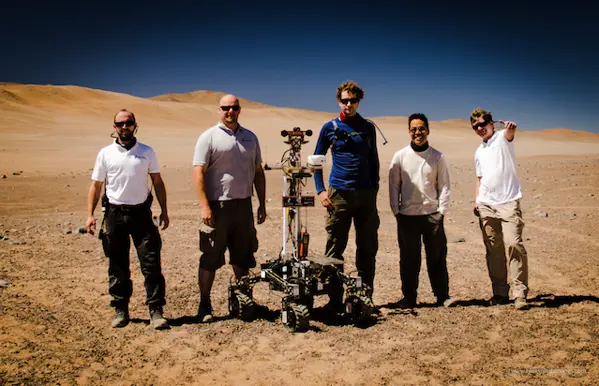
Through a partnership with the UK Space Agency on the Mars Utah Rover Field Investigation (MURFI) project, ORI engineers and researchers undertook field trials in the Utah desert to test the performance of several of its advanced navigation and autonomous driving algorithms in realistic planetary exploration conditions over a period of several weeks.
Betty, a MetraLabs SCITOS A5 robot, designed for indoor services, was trialled at Blenheim Palace’s Great Hall and was programmed to greet tourists and provide snippets of information about the palace and its history.
Researchers and engineers from the ORI took part in the Shell EcoMarathon, part of Make the Future London. This involved the development of an autonomous vehicle which was demoed at the event alongside trials at Queen Elizabeth Park and other Shell EcoMarathon events: Rockingham (2015), Rotterdam (2015), Le Mans (2016), Cornbury Park (2016).
A team from the ORI, including Maurice Fallon and the DRS Group, competed in the Tunnel Circuit of the DARPA SubT Challenge, an international robotics competition dedicated to autonomous underground exploration.
Growth and National Recognition
The Institute has continued to grow and gain national recognition, including Prof. Maurice Fallon being named a 2021 Alan Turing Fellow for his work on robotic navigation. In 2023, the Institute was awarded the Queen's Anniversary Prize for innovation in autonomous robotics, and Prof. Newman was appointed Commander of the British Empire (CBE) for services to engineering and technology.
This period also saw the award and commencement of a number of major projects, which represented the growing breadth of research at the Institute, including:
The EPSRC Embodied Intelligence Programme Grant, through the A2I Lab, explores the building blocks of embodied intelligence to contribute to productivity in strategically important areas such as social care, manufacturing, logistics, service, inspection and agriculture. The project was later showcased at the 2026 Royal Society Summer Science Exhibition, highlighting the future of robotic assembly.
Collaborative work with Amazon Web Services for a series of projects related to AI, robotics and human-centred computing, as well as training, recognised as the Human-Machine Collaboration Programme.
The AutoInspect project, which aimed to develop an automated pipeline for robotic inspection and data management for the energy and construction sectors. This project was later recognised in the 2026 University of Oxford Vice-Chancellor’s Awards, winning the Collaboration for Innovation Award.

ORI’s robots have been involved in numerous trials, including Spot at Blenheim Palace

The DigiForest team in the Forest of Dean for a trial to support sustainable forestry management

The ORI team at the Royal Society Summer Science Exhibition 2026. The team was led by the A2I and SRL research groups
Research also focused on broader themes such as:
Health and well-being:
Leveraging ORI’s autonomous vehicle (AV) research to investigate how cycling infrastructure influences cyclist behaviour and safety during real-world journeys.
Robot-assisted social care training, using robots programmed to take on different life-like characteristics and health concerns.
Environmental management:
Developing 3D mapping for sustainable forestry with trials at Wytham Woods, Switzerland and Finland.
Improving efficiency of autonomous underwater vehicles for ocean sampling.
Assessing the state of species diversity and ecosystems in the UK at Wytham Woods and Blenheim Palace in collaboration with the Department of Biology, University of Oxford
This period saw Prof. Fallon commercialise his research on construction-mapping through NavLive, which was recognised at the Mathematical, Physics and Life Sciences Division Impact Awards 2025, winning the Commercial Innovation Award.
In 2023, Associate Prof. De Martini moved to co-lead the MRG alongside Prof. Newman, while the Parker Jones Neural Processing Lab (PNPL) was established by Dr. Oiwi Parker Jones, cementing ORI’s research into foundational neuroscience, machine learning methods development, and systems applications such as Brain-Computer Interfaces (BCIs). Prof. Hawes has since also commercialised his research on decision-making software for autonomous robots in challenging environments, co-founding Stateful Robotics.
In 2024, the ORI furthered its focus on learning and development through partnering with the University of Manchester and the University of Glasgow on the RAINZ Centre for Doctoral Training to train and develop the next generation of multi-disciplinary robotic systems engineers needed to enable the net zero transition.
The PNPL group launched an annual competition in 2025, with the initial focus on progressing the field of decoding speech from non-invasive brain data. The inaugural competition focused on developing a benchmark for decoding speech from non-invasive brain recordings. The second competition in 2026 focused on word classification and efficient generalisation of models.
The Institute has grown further in its tenth anniversary year, as it welcomed its inaugural cohort of students on the MSc in Autonomous Robotics course; while Associate Prof. Digby Chappell joined the Institute, creating the Human Enhancing and Augmenting Technology (HEAT) focusing on assistive and rehabilitative technology, such as robotic prostheses and exoskeletons. Associate Prof. Robert Baines joined the Institute, creating the Protean Robotics Lab (PRL) with the goal of realising robots that morph shape, adjust control policy, and adapt to a variety of loco-manipulation tasks in challenging environments.
Prof. Hawes joined the government's Robotics Advisory Group to inform policy on robotics and autonomous systems, cementing ORI’s influence on the UK robotics ecosystem.