21 Jul 2026
Oxford’s Embodied Intelligence research showcased at the Royal Society Summer Science Exhibition
Research from the EPSRC Programme Grant on Embodied Intelligence, based within the Oxford Robotics Institute, was showcased at the Royal Society Summer Science Exhibition, where visitors explored the challenges of robotic assembly through a series of interactive demonstrations

Professor Perla Maiolino demonstrating the Institute’s soft robotic hand to a young attendee at the Royal Society Summer Science Exhibition
Robots have become central to manufacturing and assembly, taking on roles that range from heavy repetitive labour to precision tasks that would be difficult for humans to perform consistently. However, even with the growing use of automation, many complex manufacturing tasks remain a frontier challenge for robotics, requiring the ability to sense, coordinate, dynamically adapt, and learn.
The challenges of intelligent systems interacting with the physical world and the difficulties in teaching robotic coordination, precision and control – of embodied intelligence – were at the heart of the “Hands-on, Hands-off and Hand-in-hand: The Future of Robotics Assembly” display at the Royal Society Summer Science Exhibition. The annual event took place from 30 June to 5 July and showcased the latest in research and innovation from across the UK, attracting just under 11,000 visitors this year.
The Institute’s participation at the exhibit was supported by the EPSRC Embodied Intelligence Programme Grant, which funds research aimed at building machines that integrate sensing, acting, and collaboration, developing intelligent solutions that create value for society – including manufacturing.
The exhibit showcased research from the Applied Artificial Intelligence (A2I) Lab, led by Professor Ingmar Posner, who is also PI of the Embodied Intelligence Programme Grant and a Founding Director of the Oxford Robotics Institute. Researchers from A2I demonstrated Frank – a cutting-edge dual-arm robotic manipulator, which is used to develop innovative machine learning methods for collaborative manufacturing. In particular, Frank is used to train world models that allow robots to perceive and understand their environment so that they can assist humans in a small-batch manufacturing context.
Throughout the display, visitors had the opportunity to learn about the technologies that power robotics with demonstrations showcasing Frank’s abilities to assemble constructed beams, which is typically a manual task.
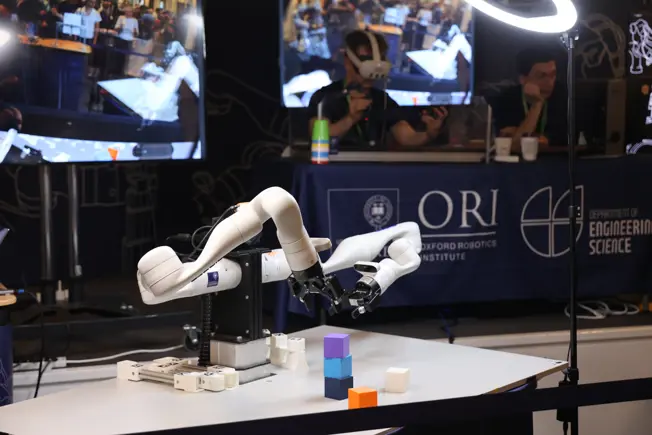
To underscore the importance of robotic learning – where repetition, demonstration, and simulation are key – the team used a teleoperation platform to run demonstrations of Frank stacking blocks and building cup towers, and even played noughts and crosses with some of the younger attendees. Using augmented reality with Meta's Quest headset, the team could operate Frank from the stage while perceiving its 3D camera point of view. For one session, several Fellows of the Royal Society got the opportunity to teleoperate the real Frank.
Members of the public were able to get hands-on with several robotic setups, too. Using a controller that mimicked the teleoperation platform used to control the real Frank, visitors could play a teleoperation game to see how quickly they could stack three blocks in a simulation environment.
With around 745 members of the public playing the game, the majority quickly realised that what appears to be a seemingly simple task is actually much harder than they thought, given the difficulties of robotic coordination and the need to plan. This was mirrored in the audience feedback from the event, with 37% of respondents feeling like they learned something new, and 23% of respondents acknowledging that robotics is harder than they realised.
Elsewhere, the exhibit had 3D-printed S101 robotic arms, where a leader arm is used to control a follower arm. Members of the public got to play with these and perform tasks – like stacking and arranging blocks – to gain a first-hand understanding of the challenges of embodied intelligence. With researchers and staff from across the ORI supporting the exhibit, visitors had the opportunity to learn how the Institute is advancing intelligent solutions that truly work for diverse applications in society, not least in industry.
Kate Lampo, a DPhil student at the ORI and one of the researchers supporting the demonstrations, said: “The most rewarding part of the exhibition was the opportunity to speak with a wide range of guests, including schoolchildren and teachers, young adults, families, non-STEM professionals, and many others. Each visitor brought a different perspective to the topics of robotics and AI: some optimistic, some wary, and many who were simply eager to learn more."
She continued:
"The expo allowed us to ground the field of robotics in reality for many of our visitors. In general, people were impressed by the technology we demonstrated but also surprised to learn about just how much progress there still is to be made, especially when it comes to creating reliable systems that operate in unstructured, real-world environments.”

Visitors to the exhibit had the opportunity to get hands-on with 3D printed S101 robotic arms

Visitors to the exhibit play a teleoperation game, challenging the operators to stack blocks using robotic arms
The Institute’s soft robotic hands from the Soft Robotics Lab (SRL) were also on display, demonstrating the importance of the sense of touch in embodied intelligence. The soft robotic hands are covered in flexible, sensor-rich artificial skin that can detect pressure, texture, and contact in real time. This instant, tactile feedback is essential for assembly tasks that require delicate control and where a fraction of a millimetre matters. The team, led by Professor Perla Maiolino, demonstrated how the soft robotic hand responds to pressure and can grasp various objects.
Speaking after the exhibit, Professor Posner said:
“Robot manipulation remains one of the frontier challenges in robotics, and people are often surprised by just how difficult seemingly simple tasks are for robots. This is why it’s so important to bring robots out of the laboratory and into direct contact with the public. Giving people the opportunity to experience these challenges first-hand helps them understand the technological challenges, inspires the next generation of scientists and engineers, and starts informed conversations about how advances in robotics and AI translate into real societal and economic impact.”
He continued, “It was a pleasure and a privilege for the Embodied Intelligence Programme Grant to be selected to showcase our research at the Royal Society Summer Science Exhibition, the UK’s flagship public science event.”
You can find out more about the EPSRC Embodied Intelligence Programme Grant here.


