01 Oct 2026
Researchers and collaborators gather to celebrate ten years of the Oxford Robotics Institute
Over 140 researchers, alumni and industry partners gathered in Oxford to celebrate the landmark anniversary of the Institute, recognising a decade of contributions across robotics, autonomous systems and artificial intelligence

Researchers, alumni and industry partners gathered in Oxford to celebrate ten years of the Oxford Robotics Institute
On Friday, 25 September, the Oxford Robotics Institute (ORI) welcomed researchers, alumni, project partners and industrial collaborators to the Thom Building, University of Oxford, for a day of talks, demonstrations and discussions marking ten years of the Institute. The celebration looked back at ORI’s origins and ahead to the future of robotics research, before closing with an evening reception at the University of Oxford Museum of Natural History.
Since its founding in 2016, ORI research has put the UK's first autonomous car on public roads, sent robots into nuclear facilities and forests, and taken field trials everywhere from the Atacama Desert to the Scottish Highlands. Now home to over 100 people, the Institute was awarded a Queen's Anniversary Prize in 2023 for innovation in autonomous technologies in recognition of the Institute’s real benefit to wider society.
The tenth anniversary event focused on the Institute’s history and foundations. The day covered the Institute's evolution into its current nine research groups spanning autonomous systems, artificial intelligence, tactile sensing and body-interfacing robotics. Each of the current Principal Investigators (PIs) from ORI’s research groups gave a talk about their past, current and future research focuses.
Opening the day, Prof. Nick Hawes, Director of the ORI and PI of the Goal-Oriented Long-Lived Systems (GOALS) group, discussed the applied nature of ORI’s work – summarised in the theme of “Robotics for Good” – in which robotic solutions are being developed to help solve real-world problems across environmental management, energy, social care and manufacturing. Prof. Hawes emphasised the importance of collaboration between academia and industry in achieving this and shaping the Institute’s legacy.
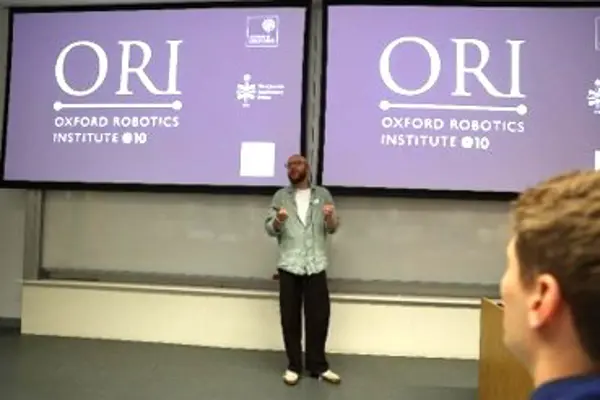
The focus on collaboration was echoed in the talks given by the Institute’s PIs and event attendees. Discussing the future of the ORI, Prof. Ingmar Posner, co-founder of the ORI and PI of the Applied Artificial Intelligence Lab (A2I), stressed the need for a systems approach to robotics, in which cross-functional collaboration is critical to leveraging AI for real-world applications. Prof. Posner also spoke to the need for ongoing funding support to allow these opportunities. In response to questions from the audience, speakers emphasised that partnerships between academia and industry can be symbiotic, offering new perspectives and scalability for solutions to real-world issues, respectively.
Throughout the day, discussions also focused on the positive culture of the ORI. Alumni were invited to share their experiences at the Institute and offer insights into how it has shaped where they are now. Presentations were given by alumni working in international non-governmental organisations, technology investment, academia and physical AI. Chi Tong, MRG alumnus and current Technical Director at Wayve, said: “The ORI is one of the best robotics labs in the world and is a great place to start and build a career. You gain access to cutting-edge research in physical AI, grounded in real-world, practical impact.”
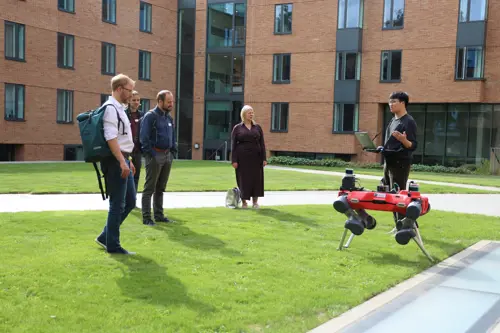
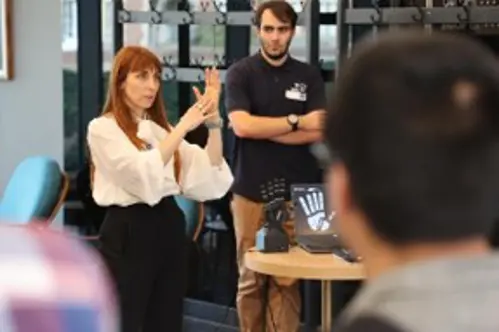
Five demonstrations in the afternoon gave attendees a first-hand look at the latest research from the Institute. Among these, researchers from A2I demonstrated Frank – a cutting-edge dual-arm robotic manipulator, which is used to develop innovative machine learning methods for collaborative manufacturing. Using a controller that can be deployed on a physical robot, attendees were invited to play badminton with a simulated version of a PhyBot C2 humanoid to showcase the Articulated Robotics Group’s (ARG) research on robotic control for dynamic tasks; and had the opportunity to interact with ANYmal C by blocking the robot's path to help showcase the Dynamic Robot Systems Group’s (DRS) work on object avoidance and route replanning.
Speaking after the event, Prof. Hawes said: “Ten years on, what stands out most is the community ORI has built. Seeing so many alumni, partners and colleagues in one room was a powerful reminder that our impact comes from people who take ambitious ideas out of the lab and into the real world. As we look to the next decade, we're focused on robotics that is trustworthy, works reliably over the long term, and helps to solve problems that matter to society.”
Explore more of ORI’s history here. Interested in collaborating with the ORI? Get in touch here.


